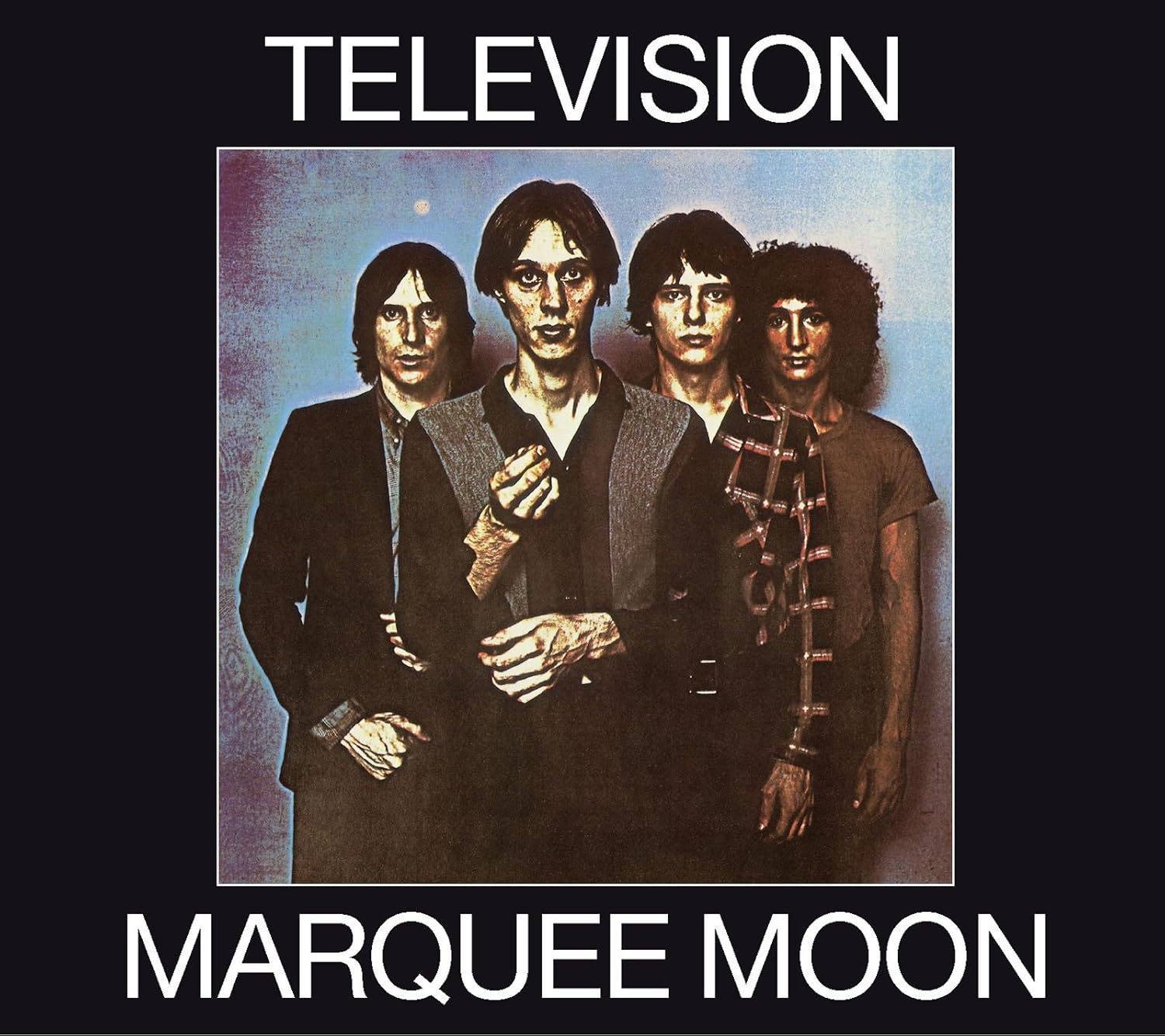
Television
Marquee Moon
About This Review
Re-Play reviews look back at landmark albums — how they were received at the time of release, the influence they've had on music in the years since, and where they stand today.
At Release
Television had been playing CBGB since the club opened in 1974, which made them founding figures of the scene by the time Marquee Moon arrived in February 1977 — and yet the album bore almost no resemblance to anything else the scene had produced. The Ramones had defined one possibility: compression, speed, the song as blunt instrument. Patti Smith had defined another: poetry and rock theater fused by force of personality. What Tom Verlaine and Richard Lloyd were doing with two guitars didn't fit either model. They had been listening to jazz — Verlaine cited Coltrane as a primary influence — and to the clean, note-specific playing of the early British Invasion, and they had arrived at an approach to guitar interplay that was closer to counterpoint than to anything in the rock tradition. The songs were long. The title track ran to nearly eleven minutes. None of this was punk.
Elektra handled the release with moderate confidence. In the UK, where the music press had been primed by two years of watching punk develop and was hungry for something that extended rather than exhausted its possibilities, the reaction was immediate and emphatic. NME named it album of the year. Sounds gave it a five-star review and called Verlaine's guitar work unprecedented. The record entered the UK charts at number 28, which was a respectable commercial performance for something this determinedly uncompromising. In the United States, the response was more muted — Marquee Moon found its audience through college radio and word of mouth rather than through conventional promotion, and that audience was smaller but arguably more permanently affected.
The production, which Verlaine handled alongside Andy Johns, was an essential part of what made the record land the way it did. Johns had worked on Led Zeppelin albums and brought a clarity to the recording that allowed every note in Lloyd and Verlaine's interlocking lines to be individually audible without the whole ever feeling clinical. The guitars didn't blur into each other or into a wall of sound — they were distinct, specific, each one legible as a separate voice. This was a technical achievement with significant aesthetic consequences: it meant that the two-guitar conversation could actually be followed, tracked, understood as argument rather than texture.
What Verlaine and Lloyd had figured out was that two guitars didn't have to divide up the roles of rhythm and lead. They could think together, in real time, the way jazz musicians think — each one aware of what the other is doing and shaping their own line in response.
The Influence
What Verlaine and Lloyd had worked out about guitar interplay had no real precedent in rock. The convention — one guitarist plays rhythm while the other takes solos — had been so thoroughly naturalized that most bands didn't recognize it as a convention at all. Television treated it as an option they had declined. Both guitarists played lead, both played support, and the boundary between the two functions was constantly in motion. The approach is most audible in the album's longer tracks, particularly the title track, where the two guitars spend ten minutes in a conversation that returns repeatedly to the same figures without ever arriving at a resolution — endlessly deferring the kind of climax that rock solos are built around.
The specific influence on post-punk and what would become indie rock is enormous and only partially documented, because it operated through imitation so thorough that the source became invisible. The Strokes built their entire first album on a reading of Marquee Moon that they absorbed through Interpol, who had made their own reading explicit. Gang of Four took the lesson about guitar as rhythmic rather than melodic instrument and pushed it toward funk. R.E.M.'s Peter Buck has said directly that Verlaine's approach to chording — the avoidance of full barre chords, the preference for open voicings that let individual strings ring clearly — reshaped his understanding of what a guitar could do in a pop context. The entire aesthetic of the early-2000s post-punk revival — Interpol, Editors, Bloc Party, Maximo Park — is meaningfully descended from decisions Verlaine and Lloyd made in a studio in 1976.
The less visible but equally significant influence is on the idea of what a rock band's relationship to jazz could be. Television didn't play jazz. But they approached rock composition with a jazz sensibility — the preference for group improvisation over individual heroics, the interest in extended form, the treatment of repetition as a means toward transformation rather than as a limitation. This sensibility, absorbed rather than copied, can be heard in Sonic Youth's approach to collective noise, in the compositional instincts of the early Radiohead, and in virtually any rock band that has decided the interesting thing about a guitar solo is not how fast it goes.
Where It Stands Today
Television broke up in 1978, just over a year after Marquee Moon was released, before the full weight of what they had made had been recognized. Verlaine pursued a solo career of considerable quality and increasing obscurity. He died in January 2023, and the obituaries gave Marquee Moon the kind of reception it had largely been denied at the time of release — a unanimous recognition, across every music publication that could be said to have opinions about such things, that this was one of the defining records in the history of the instrument.
What holds up, specifically, is the guitar playing — not as a museum piece but as a living argument about what electric guitars can do when freed from the requirements of the blues scale and the rock solo convention. The lines Verlaine and Lloyd play across the album's nine tracks remain more inventive, more surprising, and more musically sophisticated than almost anything in the genre they helped create. The title track in particular has the quality of a piece of music that has not been fully understood yet — it rewards the hundredth listen with details not audible on the ninety-ninth, which is precisely what the best records in this series share. Albums that give everything up on first contact eventually stop being necessary. Marquee Moon has never fully given itself up, which is why it is still being listened to, still being learned from, and still sounding like something nobody else thought to try.