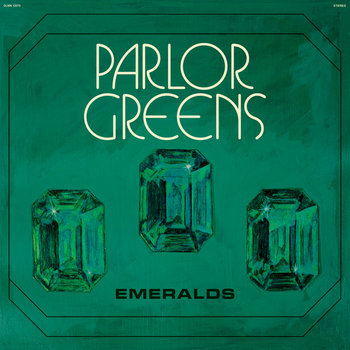
Parlor Greens
Emeralds
There's a particular kind of confidence that comes not from technical showboating, but from three musicians who simply trust each other. It's the kind you hear in the first eight bars of "Eat Your Greens" — the opening salvo of Emeralds, the sophomore long player from Parlor Greens — and it doesn't let up for the album's entire run. This is organ trio music made with uncommon care, uncommon chemistry, and, it turns out, uncommon emotional weight.
Parlor Greens is Tim Carman (formerly of GA-20) on drums, Jimmy James (of The True Loves, formerly of the Delvon Lamarr Organ Trio) on guitar, and Adam Scone (Scone Cash Players, The Sugarman 3) on organ. On paper, it reads like a supergroup assembled in someone's wildest funk fantasy. In practice, it sounds even better than that. These are three musicians who have each spent careers embedded in the tradition — the lineage of Dr. Lonnie Smith, Melvin Sparks, Bernard "Pretty" Purdie, Charles Earland, Richard "Groove" Holmes, and Brother Jack McDuff — and who understand that honoring that tradition doesn't mean being constrained by it.
These aren't flashy musicians, but they're musicians who understand space and patience.
Their 2024 debut, In Green, We Dream, announced the trio as a serious force: tight, loose, joyful, and street-smart. Emeralds deepens all of that, but it carries something the debut didn't have to carry — grief. All three members were navigating personal losses during the recording sessions, and while this album is not a somber record by any stretch, that weight is present in the music, lending it a dimension that separates it from the merely excellent.
Track by Track The album opens with "Eat Your Greens," the lead single and a statement of intent. Scone lays down a crisp bed of Hammond B3 sounds while Carman locks in with what can only be described as military ease — a Charles Earland-inspired four-on-the-floor pulse that drives guitar and organ forward like a freight train. This is funk as motion rather than mood: lean, forceful, impossible to resist, and absolutely impossible to sit still during. If you were on the fence about this band before, you won't be after 30 seconds.
"Mustard Sauce" follows with piquant, percussive funkiness that brings things to a full rolling boil. The cooking metaphors aren't accidental — Parlor Greens have a knack for titles that feel lived-in and unpretentious, names that sound like something overheard in a kitchen or a barbershop rather than drafted in a studio.
"Drop Top" is one of the album's subtler pleasures. James's guitar moves here with the same sobering, measured cadence one associates with William Bell's classic "I Forgot To Be Your Lover" — unhurried, purposeful, every note earning its place. It's a track that rewards patience, unfolding slowly until Scone edges into a solo that feels less like a performance than a conversation.
"Parlor Change" provides a moment of internal reflection midway through the first side — a groove that feels like the trio settling into themselves, checking in with each other. It has the ease of a band playing for the room rather than the record, and it's all the better for it.
The title track "Emeralds" sits at the album's center as something of an anchor. There's a shimmer to Scone's organ work here — something that justifies the jewel imagery of the album's title — while Carman and James orbit around him with barely contained energy. It's the kind of track that reminds you how much space an organ can fill and how much restraint it takes to leave room inside that fullness.
"Letter To Brother Ben" is a gospel-tinged shuffler that gives Carman the spotlight he deserves. This man plays the best shuffle this side of the Mississippi, and here he gets the canvas to prove it. There's a churchy warmth to the track, a sense of communal memory, that feels especially resonant given the personal losses the band was carrying through these sessions. It's the album's most tender original.
"Francisco Smack" injects momentum back into the proceedings — a slightly harder-edged instrumental workout that showcases the trio's tighter, funkier tendencies. After the emotional depth of "Letter To Brother Ben," it's a breath of fresh air and an indication that Emeralds knows exactly how to pace itself.
Then comes "Jolene." Yes, that "Jolene." Dolly Parton's timeless plea for romantic mercy might seem an unlikely destination for a Hammond organ trio, but Parlor Greens make the case effortlessly and irresistibly. The transformation is not a novelty — they don't play it for laughs or for surprise. They play it like they mean it: funky, aching, alive. It may be the album's most purely joyful track, and proof that a great melody is a great melody regardless of the instrument or idiom.
"Lion's Mane" opens with a nod to Horace Silver's "Song For My Father" — Scone easing into that familiar refrain before using it as a springboard rather than a destination. The trio builds from that soul jazz foundation into something harder and more psychedelic: by the time James unspools his solo, the whole thing has drifted toward the atmospheric, Band of Gypsies-era Hendrix territory. It's one of the album's most adventurous moments and a reminder that this is not a band content to stay in any single lane.
"Red Dog" channels the absolute heaviest shade of early R&B, with James's crunchy guitar paving the way for dual solos — first guitar, then organ — that burn rather than boast. There's grit and swagger here, an old-school ferocity that feels completely natural coming from these three players.
The album closes with "Queen Of My Heart," and it is a gut-punch in the most beautiful sense. Jimmy James wrote this tune for his mother shortly after she passed away, and the sweet-shimmering finale builds to something almost unbearable in its gentleness. Its closing moments include a tender, loving conversation between Jimmy and his mother — the final recording he has of her before she died. It is a profound, quietly devastating way to end a record. The fact that it doesn't derail the album's overall spirit of joy and vitality says everything about the emotional intelligence of the musicians involved. Grief and gratitude can coexist, and here they do.
The Bigger Picture Emeralds succeeds not only as a showcase of technical craft but as a document of what instrumental music can hold. In the hands of lesser players, a Dolly Parton cover risks feeling like a gimmick; a closing dedication to a departed mother risks feeling maudlin. Parlor Greens navigate both without breaking a sweat, because everything they do comes from the same place: genuine feeling, honestly expressed, with the chops to back it up.
The organ trio format is one of the most elegantly constrained in American music — three voices, no bass, and every player pulling double duty rhythmically and melodically. Parlor Greens understand that constraint is not limitation but focus. Every note on Emeralds is a choice, and the choices are consistently impeccable.
Colemine Records has built a reputation for releasing records that sound like they were made in a different, better era, and Emeralds is a crown jewel of their catalog. It doesn't sound dated. It sounds timeless, which is a harder thing to achieve. The album draws from the legacies of Blue Note and Prestige-era organ masters without ever turning nostalgia into artifice.
If the debut announced the arrival of a serious band, Emeralds confirms the arrival of a great one. It's the rare sophomore record that deepens everything its predecessor promised — richer, warmer, and more emotionally complex without sacrificing a single ounce of the groove. In a world that often mistakes busyness for depth, Parlor Greens remind us that the deepest grooves are often the simplest ones, played by people who have actually lived something worth saying.