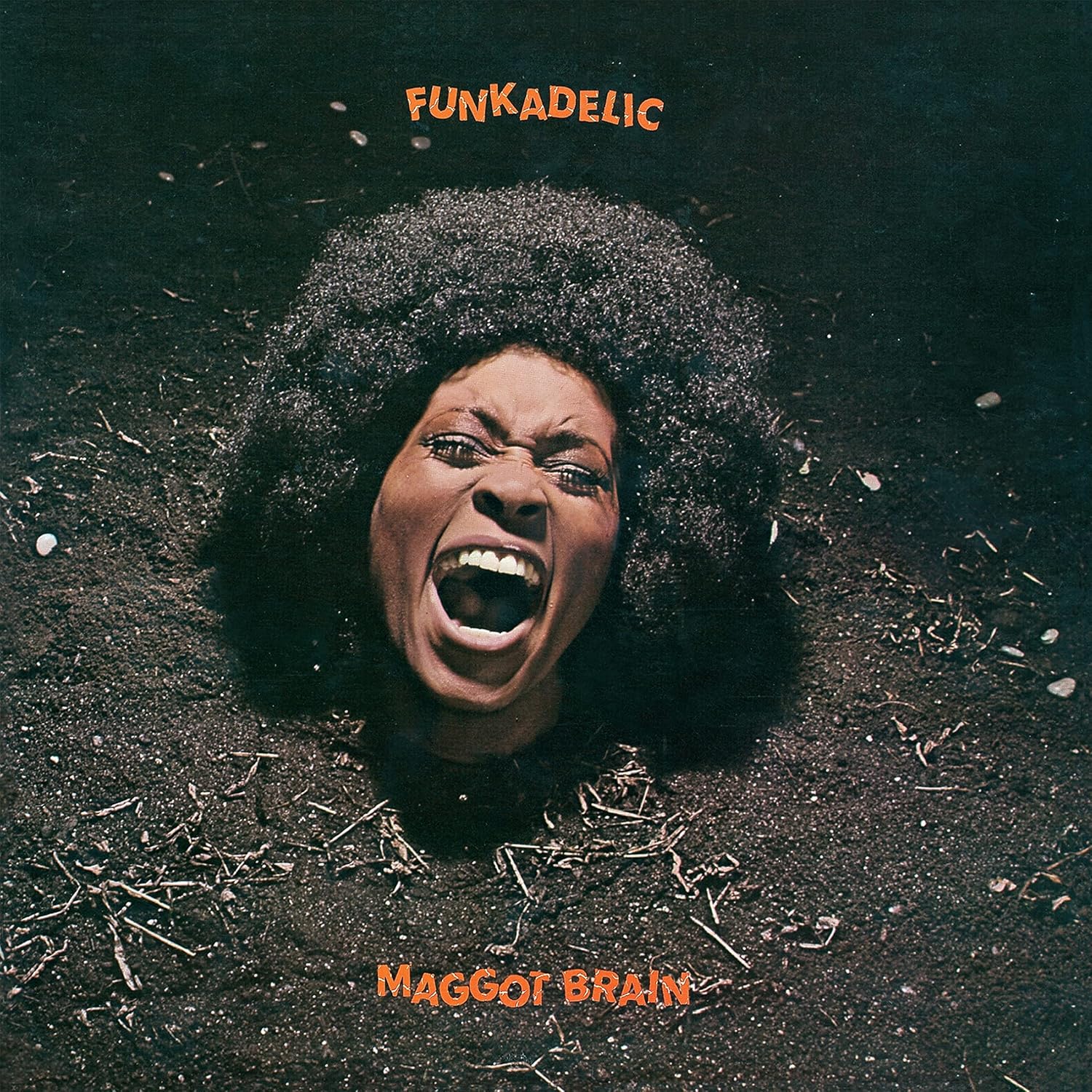
Funkadelic
Maggot Brain
About This Review
Re-Play reviews look back at landmark albums — how they were received at the time of release, the influence they've had on music in the years since, and where they stand today.
At Release
The story attached to the opening track of Maggot Brain has been told often enough that it has acquired the quality of myth, which does not make it less true: George Clinton told Eddie Hazel to play as though he had just been told his mother was dead, and then — as Hazel was playing — told him she was alive after all. What Hazel produced in that single performance, recorded in one take and lasting just under ten minutes, is the most emotionally comprehensive piece of electric guitar playing ever committed to a rock album. Clinton's decision to bring the mix down to almost nothing beneath it — stripping away everything except a faint synthesizer drone — turned a remarkable performance into an overwhelming experience. Maggot Brain's opening moments announce an album that will not be asking your permission.
Westbound Records released the album in July 1971, and the music press largely did not know what to do with it. Funkadelic occupied an awkward position in the cultural landscape of 1971: too psychedelic and too rock for the R&B audience, too funky and too Black for the rock press, too musically radical for the pop market. The band existed in a space that the music industry's categorical structures had not prepared for, which meant that the records circulated primarily through live performance reputation and word of mouth rather than through conventional promotional channels. The title track was not played on the radio. The album did not chart significantly. None of this was surprising, and none of it ultimately mattered.
The rest of the album after 'Maggot Brain' does not attempt to sustain the title track's emotional register — it would be impossible and probably inadvisable to try. What follows is a set of songs that range from the psychedelic funk of 'Can You Get to That' to the extended proto-metal workout of 'Super Stupid,' which sounds in 1971 like a band that has listened to Black Sabbath's debut and decided to double its tempo and half its solemnity. The sequencing places the listener in a condition of productive disorientation: having been taken apart by the opening track, you are reassembled in stages, each song operating from a different set of premises about what Funkadelic is and what it wants from you.
Maggot Brain demonstrated that Hendrix and James Brown occupied the same territory approached from different directions, and that the vast space between them was available for habitation — a discovery that Prince would spend his career elaborating.
The Influence
Maggot Brain's influence divides along the fault line of its own internal contradictions. The title track alone has been claimed as a foundational text by the electric blues tradition, by psychedelic rock, by metal, by soul, and by every musician who has ever confronted the question of how much emotional weight a solo instrument can be asked to carry. Tom Morello has cited Hazel as a primary influence. The Edge has spoken about the title track's approach to sustain and space. An entire generation of alternative rock guitarists who came of age in the 1990s — from Liz Phair to Kim Thayil — identified Hazel's playing as the standard against which emotional directness in electric guitar should be measured.
The album's broader influence on what became known as P-Funk and subsequently on all funk-derived popular music is structural rather than stylistic. Maggot Brain demonstrated that the funk tradition could accommodate the most extreme psychedelic rock ambitions without diluting either — that Hendrix and James Brown occupied the same territory, approached from different directions, and that the space between them was available for habitation. Prince's entire career is in some sense an elaboration of this demonstration. D'Angelo's guitar playing on Voodoo returns to Hazel's approach with explicit acknowledgment. The Red Hot Chili Peppers drew from the album's willingness to allow rock excess and funk precision to coexist in uneasy but productive tension.
Where It Stands Today
Maggot Brain has one of the most unusual critical trajectories in rock history: it was significantly underappreciated at the time of its release, moderately appreciated in the decade following, and has been growing in critical and popular stature every year since. The album now appears on virtually every significant greatest-records list, and the title track in particular has acquired a kind of sacred status among guitarists that borders on the devotional. When magazines and critics rank the greatest guitar performances in rock history, 'Maggot Brain' is invariably present, and invariably near the top.
What justifies this status, beyond the mythology, is the quality of the listening experience itself. The title track does not age because it is not playing to any period's conventions — it is playing to the human nervous system's response to sustained emotional intensity, which is not a period phenomenon. The rest of the album holds up with more variation: some tracks have dated in specific production details, while others — 'Wars of Armageddon' in particular, with its long, collapsing coda — sound as genuinely strange today as they did in 1971. As a complete statement, it is indispensable. As an opening track, it remains an act of creative violence that has never been surpassed.