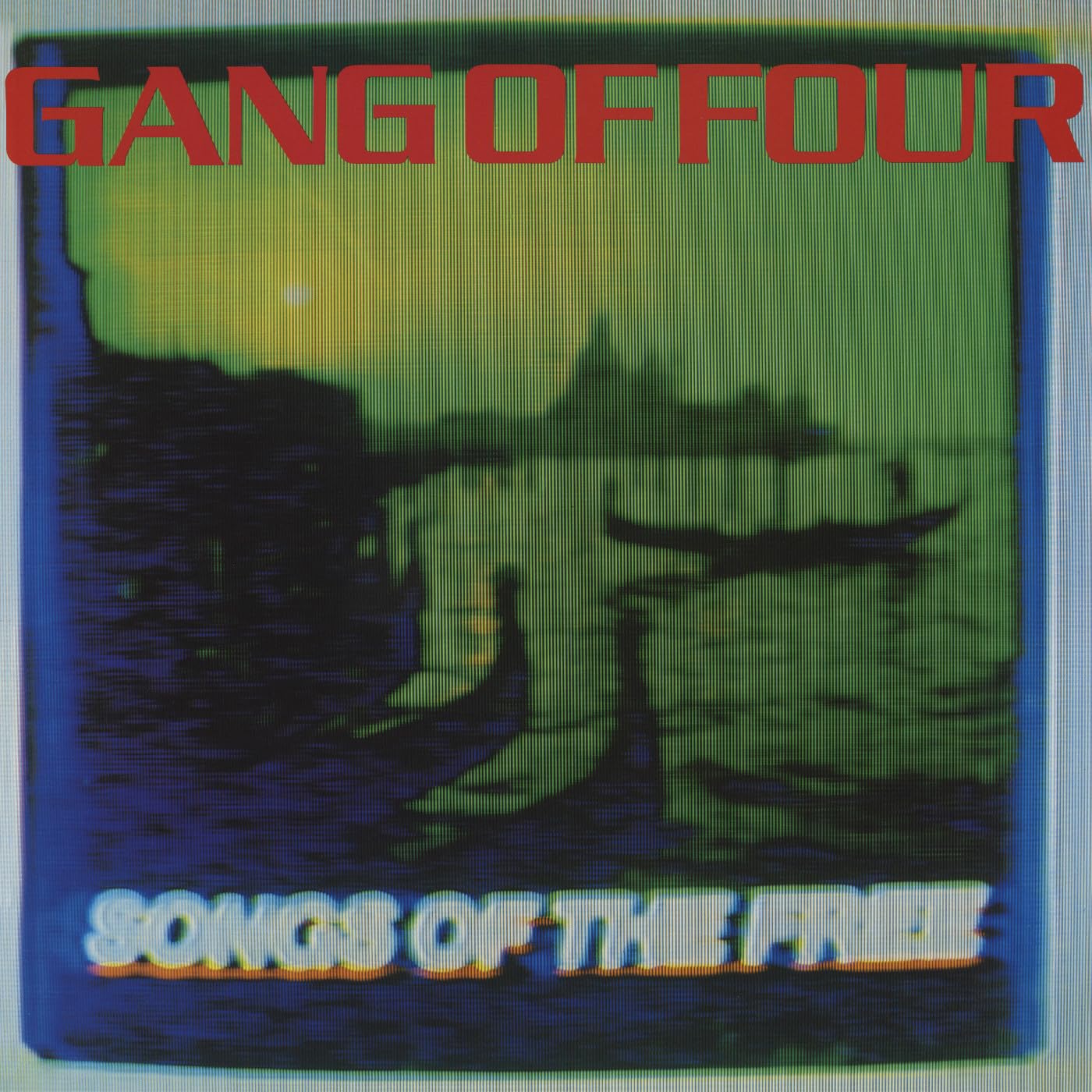
Gang Of Four
Songs of the Free
About This Review
Re-Play reviews look back at landmark albums — how they were received at the time of release, the influence they've had on music in the years since, and where they stand today.
At Release
By the time Songs of the Free arrived in May 1982, Gang of Four had already made two albums that were recognized as important: Entertainment! and Solid Gold. The band's political commitments, their theoretical debt to Althusser and the Frankfurt School, and their radical deconstruction of funk as a vehicle for ideology rather than pleasure had established them as perhaps the most intellectually serious rock band in Britain. Songs of the Free was the record on which they decided to test whether those commitments could survive contact with a mainstream production aesthetic, and the results were contentious.
The album sounds like a band in negotiation with itself. The funk influence remains — Busta Jones's bass work and Hugo Burnham's drumming maintain the rhythmic intelligence that had always distinguished the band — but Andy Gill's guitar has been moved back in the mix, and Jon King's vocals have been given more conventional melodic treatments. 'I Love a Man in Uniform,' the lead single, reached number 65 in the UK charts, which was both the band's best commercial performance and a source of significant discomfort, since it was banned by the BBC due to the Falklands War context in which its title acquired an uncomfortable resonance.
The critical reaction split largely along lines of ideological investment. Those who had admired the earlier records for their formal rigor found the more polished arrangements a dilution. Those who came to the record from a more straightforwardly pop perspective found it overly conceptual. The band itself was essentially dissolving during the recording — the lineup would be radically altered before the next album, and King and Gill's relationship was operating under considerable strain.
Songs of the Free demonstrates that political music does not have to be dour, that critique can be delivered inside a groove that makes the body want to move even as the mind is being asked to engage with uncomfortable propositions.
The Influence
Gang of Four's influence has been more comprehensively documented than that of almost any band in this survey, largely because the artists who have cited them span an unusual range of genres. Red Hot Chili Peppers absorbed the funk-punk tension and discarded the theory. Michael Stipe has frequently named Entertainment! and Songs of the Free as foundational texts for R.E.M.'s approach to rhythm. Kurt Cobain listed Gang of Four among Nirvana's primary influences, which is audible in the rhythmic approach of much of Nevermind.
The specific contribution of Songs of the Free to this tradition is the demonstration that political music does not have to be dour, that critique can be delivered inside a groove that makes the body want to move even as the mind is being asked to engage with uncomfortable propositions. 'We Live As We Dream, Alone' and 'It Is Not Enough' do this with a precision that later protest-adjacent musicians — Rage Against the Machine, TV on the Radio, Sleater-Kinney — reached for and sometimes achieved. The model was here, available, and largely underused.
Where It Stands Today
Songs of the Free has aged better than its reputation in 1982 suggested it would. The compromise between formal rigor and pop accessibility that seemed like a concession at the time now reads as an intelligent pragmatic decision — the album demonstrates that the tension between these positions is generative rather than fatal. It is a messier record than Entertainment!, but it is also a more human one, made by people who were genuinely uncertain about their choices in a way that the earlier records, for all their brilliance, sometimes concealed.
The production has dated in specific ways — some of the drum sounds carry the fingerprint of early 1980s studio technology in ways that are unavoidable. But the rhythmic concepts underneath those sounds remain completely vital. The interlocking guitar and bass patterns, the deliberate refusal to fill every space, the use of silence as both a political and a musical statement: these are not techniques that age because they are not really techniques at all. They are dispositions toward music-making, and dispositions can be carried forward intact across any number of technological generations.