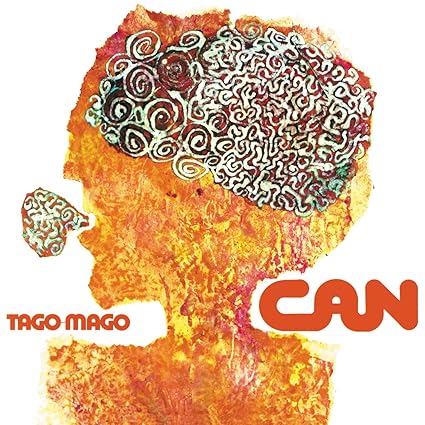
Can
Tago Mago
About This Review
Re-Play reviews look back at landmark albums — how they were received at the time of release, the influence they've had on music in the years since, and where they stand today.
At Release
Tago Mago did not arrive so much as it materialized, a double album released in 1971 by a group of West German musicians whose collective background spanned Stockhausen's composition seminars, free jazz, and American soul — a combination that produced music unlike anything available on either side of the Atlantic. Can had already released Monster Movie and Soundtracks, records that established them as a serious and unusual concern, but Tago Mago was the moment when their synthesis of improvisation, repetitive groove, and studio manipulation reached its full and alarming realization. The album runs to approximately seventy-three minutes across two LPs, and it contains exactly the number of conventional rock songs you would expect from a band that had effectively decided to redesign the form from its foundations: none.
The commercial and critical reception in 1971 was, not surprisingly, limited. German rock had not yet established a vocabulary that music journalists in Britain and America were comfortable deploying, and the music press of the early 1970s was largely preoccupied with the progressive rock wave emanating from England — a tradition that Can's music superficially resembled in its instrumental ambition but fundamentally opposed in its aesthetic values. Where prog glorified technical complexity and compositional grandeur, Can pursued something closer to hypnosis: the same figures repeated until repetition stopped being boring and started being transformative. A review in Melody Maker acknowledged the album's strangeness without finding a frame for its quality. Most of the British press simply did not review it.
What was immediately grasped by those paying close attention — and there were enough of them to matter — was the centrality of Jaki Liebezeit's drumming. Liebezeit had studied jazz and had subsequently concluded that jazz's improvisatory freedoms were less interesting to him than the discipline of the locked groove. He played with a metronomic precision that was simultaneously mechanical and unmistakably human, creating a rhythmic foundation over which the rest of the band could layer freely without ever losing structural coherence. His playing on 'Halleluwah,' the album's twenty-minute centerpiece, remains one of the most remarkable sustained percussion performances in the recorded history of rock music.
Liebezeit's playing on 'Halleluwah' remains one of the most remarkable sustained percussion performances in the recorded history of rock music — metronomic yet unmistakably human, a locked groove that made repetition feel like revelation.
The Influence
Can's influence is so thoroughly dispersed through the history of subsequent music that cataloguing it requires a certain selectivity. The most immediate and direct line runs through the post-punk and krautrock-adjacent bands of the late 1970s: Public Image Ltd., whose Metal Box owed an audible debt to the locked-groove repetition of Tago Mago; the Gang of Four, who absorbed the lesson that rhythm could function as political argument; and David Bowie, whose Berlin trilogy was made in close dialogue with the specific sonic environment that Can had pioneered. Brian Eno, who produced those Bowie records, had been listening to Can since the early 1970s and has cited them as one of the primary inspirations for his developing theory of music as texture rather than event.
The influence on hip-hop and electronic dance music is less frequently acknowledged but equally substantial. The principle that a groove could be sustained without development — that repetition itself was a compositional strategy rather than a failure of invention — was something Can demonstrated for rock musicians at roughly the same time that James Brown was demonstrating it for funk. The two traditions arrived at the same conclusion from entirely different origins, and their convergence in subsequent decades produced the rhythmic architecture of virtually all contemporary dance music. When a producer today loops a four-bar pattern for eight minutes, they are working from premises that Can's music helped establish as artistically serious.
Where It Stands Today
Tago Mago has not aged in the way that most albums age. It has not become a period piece, a nostalgic artifact, or a historical document. It has instead become something more difficult to categorize: a permanent resource. Musicians continue to return to it not as an act of scholarly reverence but because it contains solutions to problems they are currently trying to solve. The rhythmic approach, the relationship between improvisation and structure, the use of the studio as a compositional instrument in its own right — these are not period techniques. They are methods.
Damo Suzuki's vocals on the album deserve a separate accounting. His approach to the voice as an instrument producing sound rather than communicating text — the syllables of 'Oh Yeah' are essentially phonemes arranged for rhythmic and tonal effect rather than semantic content — has proven almost as generative as Liebezeit's drumming. It anticipates the way that subsequent producers from hip-hop to electronic music would treat the human voice: as a sample, as a texture, as raw material for transformation. Hearing Tago Mago today is not an exercise in historical appreciation. It is a reminder of how much of what seems new is actually a continuation of something that arrived, more or less fully formed, on a West German double album in the spring of 1971.