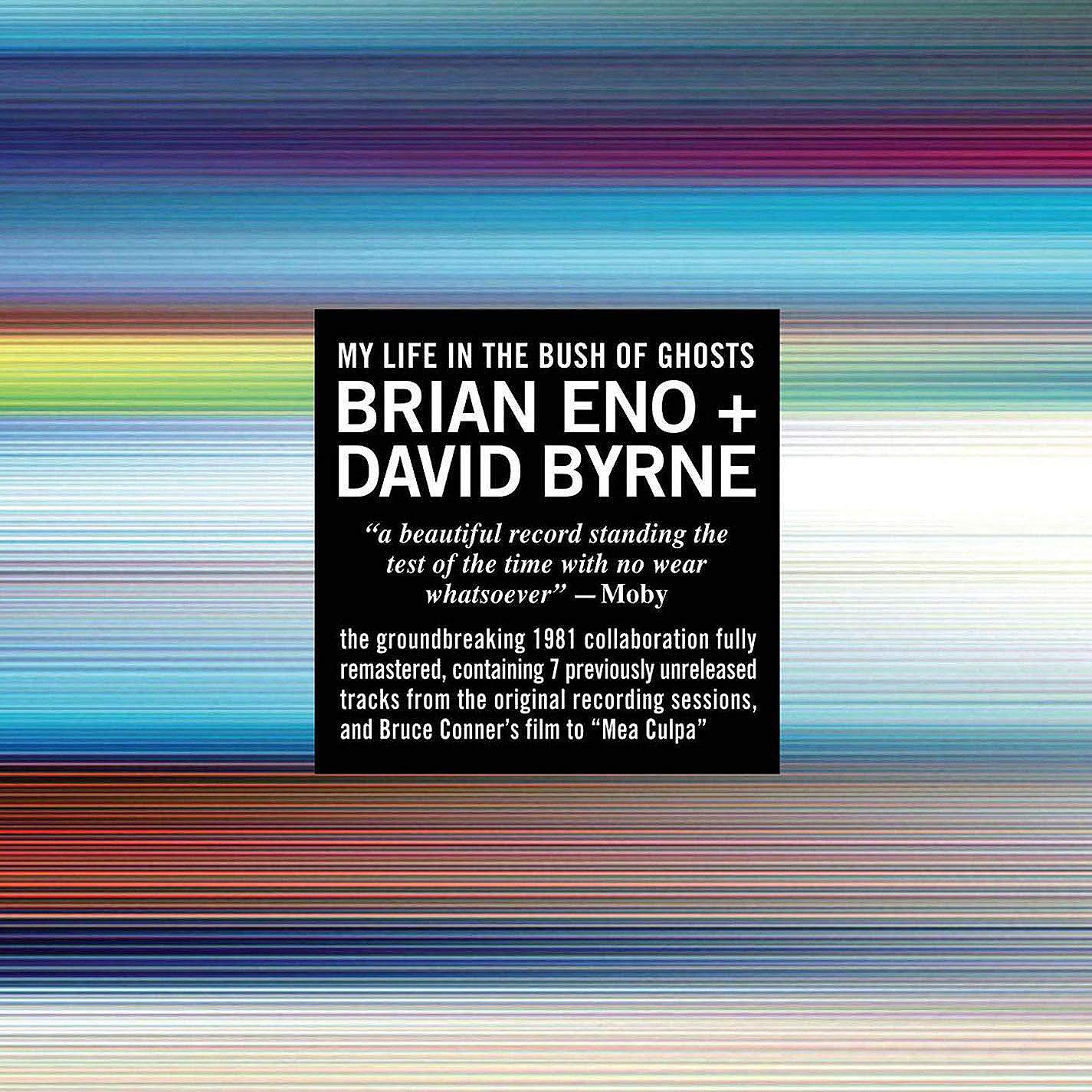
Brian Eno & David Byrne
My Life in the Bush of Ghosts
About This Review
Re-Play reviews look back at landmark albums — how they were received at the time of release, the influence they've had on music in the years since, and where they stand today.
At Release
My Life in the Bush of Ghosts arrived in February 1981 already carrying a reputation built from rumor. Eno and Byrne had been working on it, in various configurations, since 1979 — the same period during which Byrne was also completing Remain in Light with the full Talking Heads lineup, and Eno was developing the ambient series that would culminate in The Plateaux of Mirror. Word had circulated in the small community of musicians and journalists who occupied the overlap between avant-garde composition and post-punk practice that the collaboration was doing something genuinely unprecedented: using found voices — radio preachers, exorcism recordings, Arabic pop broadcasts, Lebanese mountain singers — as the primary melodic material over rhythm tracks built from African and Middle Eastern percussion patterns. The description sounded either remarkable or outrageous depending on your disposition, and the record itself was both.
Sire Records in America and EG in the UK handled it with the careful enthusiasm of labels that were not entirely sure they had signed a commercial property but were confident they had signed something significant. The reviews were long and conflicted. Critics struggled with the question of whether appropriating found voices — real people recorded without their knowledge or consent for purposes they could not have anticipated — was ethically justifiable as an artistic practice, a question that has not become any simpler in the subsequent decades. The music press of the early 1980s was not particularly well equipped to address questions of cultural appropriation; it simply noted that the combination of voices felt transgressive and largely moved on to describing the sonic experience, which was extraordinary.
The album's commercial performance was solid within its niche but it was never a mainstream proposition. Its chart positions on both sides of the Atlantic reflected the size of the audience for adventurous post-punk rather than the size of the audience for pop. One track, 'Qu'ran,' was withdrawn from the album after the initial pressing following objections from Muslim groups regarding the use of Quranic recitation as musical material — a controversy that illuminated the ethical questions the album raised without resolving them, and that gave the record an additional layer of cultural complexity that has not diminished with time.
My Life in the Bush of Ghosts did not merely anticipate sampling culture — it constituted a complete theory of it, years before the technology that would make sampling practically accessible had arrived.
The Influence
My Life in the Bush of Ghosts did not merely anticipate sampling culture — it constituted a complete theory of it, years before the technology that would make sampling economically and practically accessible had arrived. The album's central premise — that a recorded human voice lifted from its original context could be transformed into raw compositional material, that the boundary between found sound and created music was a convention rather than a law — was the premise on which virtually all subsequent sample-based music would operate. When Public Enemy's Hank Shocklee and the Bomb Squad assembled the dense sonic collages of It Takes a Nation of Millions, they were executing the same basic argument that Eno and Byrne had demonstrated was viable.
The specific influence on world music, electronica, and what would later be called global bass is equally foundational. The record's rhythmic vocabulary — drawn from Gnawa trance music, Nigerian Afrobeat, Egyptian percussion traditions — was not deployed as decoration but as structural architecture. This approach to non-Western rhythm as a compositional resource rather than an exotic color was absorbed by a generation of producers working in the space between electronic music and African and Asian traditions: from Transglobal Underground in the early 1990s through to Diplo, M.I.A., and the entire ecosystem of global club music that has defined the past two decades. Each generation has had to rediscover the album, and each has found that it had already solved the problems they were trying to work out.
Where It Stands Today
My Life in the Bush of Ghosts has aged with the authority of a work that was fundamentally right about things the world needed fifty years to fully absorb. The ethical questions it raises about the use of found voices have not been resolved — they have become more pressing, in fact, as sampling culture and digital manipulation have made the practices the album pioneered both ubiquitous and increasingly contested. The record now exists in a slightly uncomfortable position: it is recognized as a foundational document of practices that are themselves under sustained ethical scrutiny, and the recognition does not dissolve the discomfort.
What remains entirely unambiguous is the quality of the music itself. The rhythm tracks that Eno and Byrne assembled — many built from the same sessions that produced Remain in Light — are among the most sophisticated and physical groove constructions in the history of recorded music. The voices that float over them, whatever their complex ethical status, create an atmosphere of ritual and displacement that has not been replicated by any of the many subsequent attempts. 'Regiment,' 'Help Me Somebody,' and 'The Carrier' remain experiences that the listener cannot fully predict or control, which is the rarest and most valuable quality a record can possess.