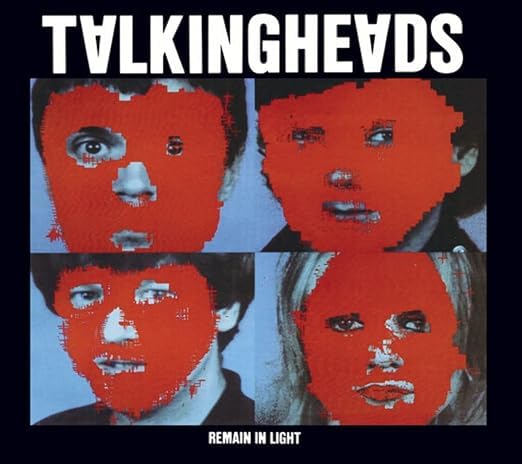
Talking Heads
Remain in Light
About This Review
Re-Play reviews look back at landmark albums — how they were received at the time of release, the influence they've had on music in the years since, and where they stand today.
At Release
Talking Heads had already made three excellent records by the time they walked into Compass Point Studios in Nassau with Brian Eno and began assembling what would become Remain in Light. None of those earlier albums prepared anyone for what emerged. The group that had once been celebrated for its angular, nervously intelligent take on CBGB-era post-punk had, by 1980, transformed itself into something that did not fit any available category. Critics writing in real time reached for the word "African" the way people reach for the nearest chair in a dark room — not necessarily the right word, but the closest available support.
The album shipped in October 1980 and was met with reviews that were almost uniformly astonished. Rolling Stone gave it five stars and admitted to being confused by it, which was perhaps the most honest critical response available. Robert Christgau, never a man who surrenders his certainty easily, wrestled with its poly-rhythmic architecture and its debt to the Fela Kuti records that David Byrne and Eno had been absorbing. The record entered the UK albums chart at number 21 and performed modestly in the United States, where its refusal to deliver a clean radio hook counted against it on commercial radio. This was, it later became clear, entirely irrelevant.
The band itself was in a state of productive internal tension during the recording. Adrian Belew came in to add guitars; the percussionist and multi-instrumentalist Jon Hassel contributed his indefinable textures; Bernie Worrell from Parliament-Funkadelic arrived to lay keyboard lines that welded cosmic funk to downtown art-rock. The resulting record was not made by Talking Heads in any conventional sense. It was assembled from a community of players with radically divergent backgrounds, guided by a shared conviction that the Western pop song form had been left in a room and was growing stale.
Remain in Light is one of those rare albums that has continued to accrue meaning rather than simply retaining it.
The Influence
Almost every significant development in what would come to be called world music, global pop, or — more recently — Afrobeats crossover has at least one of its roots in Remain in Light's wholesale dismantling of the verse-chorus structure in favor of cyclical, interlocking rhythmic patterns that never resolve in the expected direction. Peter Gabriel heard it and went to Senegal. Paul Simon heard it and went to South Africa. Vampire Weekend heard it and went to their parents' record collections and then to Columbia University, where they assembled their debut in its image. LCD Soundsystem's James Murphy has cited it as one of the defining texts of his musical education.
Byrne's vocal approach on this record — fragmented, rhythmically unpredictable, occasionally functioning as pure phoneme rather than as vehicle for semantic content — influenced a generation of singers who understood that language in music does not have to behave like language in prose. The descending bass figure on 'Once in a Lifetime' and that song's cut-and-paste sermonic delivery showed what was possible when pop stopped treating the voice as the primary instrument and started treating it as one element in a dense compositional web. Hip-hop, which was emerging simultaneously from entirely different origins, arrived independently at many of the same conclusions.
Where It Stands Today
Remain in Light is one of those rare albums that has continued to accrue meaning rather than simply retaining it. Each decade has found something new to extract from its circling grooves. In the 1980s it was the model for art-rock that took non-Western rhythm seriously. In the 1990s it was an ancestor of ambient and electronic music's engagement with repetition and trance states. In the 2000s it was the template for the guitar-band revival that ran through Strokes-adjacent post-punk revivalism. Today it reads as a document of radical creative humility — a band at the height of its commercial profile deciding to surrender its authorship to a collective process.
The album has entered the canon in a way that the most canonical albums resist: it is still played, still argued about, and still capable of producing the sensation that you are hearing something that has not quite been decoded yet. 'Seen and Not Seen' and 'Listening Wind' in particular remain genuinely strange experiences, pieces that resist the kind of comfort that familiarity usually provides. This sustained strangeness is perhaps its most remarkable achievement.