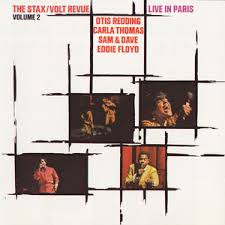
Stax/Volt Revue
Live in Norway 1968
About This Review
Re-Play reviews look back at landmark albums — how they were received at the time of release, the influence they've had on music in the years since, and where they stand today.
At Release
The Stax/Volt Revue's 1968 Norwegian tour represented the label's most ambitious international assertion of Black American soul music at the height of its commercial and artistic powers. Featuring Otis Redding, Sam & Dave, Booker T. & the M.G.'s, the Bar-Kays, and Carla Thomas, the revue functioned as a traveling institution—a mobile demonstration of Stax's house sound and its capacity to showcase an entire roster of interconnected artists. The live recordings captured at Oslo's Konserthuset documented a moment of rare synergy between established stars and rising talents, all backed by the incomparable M.G.'s rhythm section of Donald "Duck" Dunn and Al Jackson Jr. Norwegian audiences, relatively untouched by American soul's commercial machinery, received the performances with an intensity that energized every performance. The recordings remained largely dormant in archive vaults for decades, their eventual release via Stax's vault operations transforming them into a critical document of a touring enterprise that would become increasingly difficult to assemble once Redding's death in December 1967 altered the label's trajectory irreversibly.
The distance between Stax's meticulously engineered studio recordings and these unvarnished live captures reveals a institution operating at the absolute peak of its powers.
## The InfluenceThe revue format itself became a template for subsequent soul and funk touring models, influencing everything from the Chitlin' Circuit's evolution into legitimate concert venues to later assemblings of Atlantic Records talent. The live chemistry documented here—particularly the interplay between the M.G.'s instrumental prowess and the vocalists' call-and-response dynamism—directly informed how soul music would be understood as a group phenomenon rather than a collection of solo artists. Booker T. & the M.G.'s studio innovations heard on these recordings rippled through the production decisions of Motown, Hi Records, and the emerging funk experiments of the early 1970s. Sam & Dave's barnburning energy on tracks like "Soul Man" established the template for gospel-inflected soul performance that would echo through James Brown's live shows and subsequent funk ensembles.
Where It Stands Today
The 1968 Norway recordings stand as perhaps the most vivid documentation of Stax Records at its commercial and artistic zenith, unburdened by studio perfectionism and electric with the spontaneity of audience response. Modern listeners encounter a sound of astonishing clarity—the Nashville studio techniques that underpinned Stax's clean, horn-driven arrangements become three-dimensional when captured live, with the M.G.'s' rhythm section achieving an almost architectural precision that contemporary funk production has struggled to replicate. The historical weight of the Redding performances cannot be understated; hearing him in full command of his vocal instrument, pushing against and with the band's grooves, provides irreplaceable evidence of his singular artistry. These recordings have been embraced by contemporary soul revivalists and cratediggers as essential touchstones, their influence visible in modern soul acts who attempt to reclaim the ensemble approach and organic groove-building that Stax perfected. What emerges from repeated listening is an understanding that Stax Records was not merely a label but a functioning philosophy of soul music—one predicated on collective excellence, rhythmic sophistication, and the absolute primacy of the groove.
stax-volt-revue-live-norway-1968.jpg