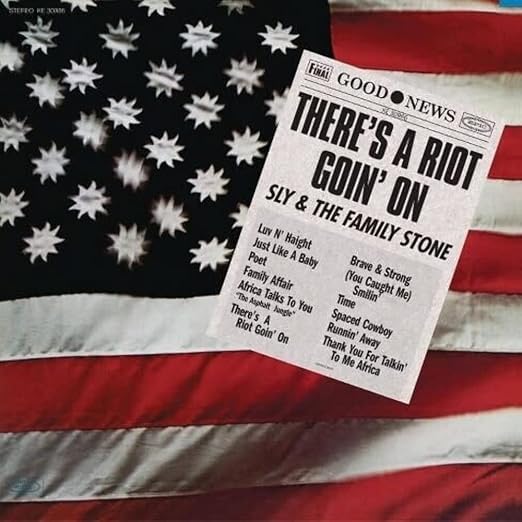
Sly & the Family Stone
There's a Riot Goin' On
About This Review
Re-Play reviews look back at landmark albums — how they were received at the time of release, the influence they've had on music in the years since, and where they stand today.
At Release
The distance between Stand! and There's a Riot Goin' On is one of the most vertiginous drops in the history of popular music. Stand! was a euphoric, communal, politically engaged record that had helped define the optimism of the late 1960s counterculture; it sold a million copies and confirmed Sly Stone as one of the defining voices of his generation. The follow-up, released in November 1971, sounded like it had been made on a different planet by a different person — which, in certain respects, it had been. The intervening years had brought drug dependency, the disintegration of the original band's communal dynamic, the shift from San Francisco to Los Angeles, and a confrontation with the limits of the utopian vision that had powered the earlier record.
The production technique was itself a provocation. Where Stand! had been built on live performance energy, There's a Riot Goin' On was assembled from overdubs, tape loops, and drum machine patterns at a time when drum machines were still widely regarded as a novelty rather than a serious creative tool. Stone recorded most of it alone or nearly alone in a home studio, layering tracks until the original performances were buried under successive generations of dubbing that degraded the sound quality in ways that were clearly intentional. The result was a record that felt claustrophobic and airless — not from technical limitation but from a deliberate aesthetic decision to make the medium reflect the message. Rolling Stone magazine, which had celebrated the earlier records, found it 'depressing' and did not know what to do with it.
The album reached number one on the Billboard 200, which is among the stranger facts in the chart history of a record so manifestly uninterested in pleasing its audience. The commercial performance was almost certainly driven by the residual loyalty of Stand! fans who bought the record on the strength of the name and were subsequently confronted with something that refused all their expectations. 'Family Affair,' the lead single, was a genuine hit and was accessible enough to suggest that the album surrounding it might be navigable. It was not, or at least not in any direction the market recognized as forward.
When Public Enemy, Wu-Tang Clan, or J Dilla reached for a lo-fi, claustrophobic sonic environment as a political statement, they were working from principles Sly Stone had established in a home studio in 1971."
The Influence
There's a Riot Goin' On is one of the most generatively pessimistic records ever made. Its influence runs through every subsequent artist who has understood that the recording studio can function as a confessional space — a place where the limitations of the process are allowed to become part of the content. Prince absorbed it directly; the claustrophobic home-studio aesthetic of albums like Dirty Mind and For You carries Stone's approach forward while replacing his despair with a different register of sexuality and mystery. D'Angelo's Voodoo, which emerged in 2000 after a seven-year absence and sounded like it had been excavated rather than recorded, is the most complete realization of There's a Riot Goin' On's aesthetic philosophy in the subsequent generation of R&B.
The album's influence on hip-hop is foundational in a way that is difficult to overstate. Its drum machine rhythms and its deliberate engagement with degraded sound quality anticipated the aesthetic of sample-based production by more than a decade. When Public Enemy, Wu-Tang Clan, or J Dilla reached for a lo-fi, dusty, claustrophobic sonic environment as a political and emotional statement, they were working from principles that Stone had established in a home studio in Los Angeles in 1971. The album also modeled the idea that an artist could respond to commercial expectation with principled refusal without surrendering commercial viability — a posture that subsequent generations of artists have found consistently useful.
Where It Stands Today
There's a Riot Goin' On is one of those records that reveals different things depending on the circumstances in which it is heard. Played at low volume through headphones in the early hours, it has an intimacy that approaches confession. Played on a system with genuine bass reproduction, it has a physical weight that belies its bleary surface texture. The drum machine patterns, which sounded primitive and unsettling in 1971, now carry the authority of precedent — we know what they led to, and hearing them in context gives them a historical resonance that was unavailable at the time of release.
The critical rehabilitation has been complete. The record is now regarded universally as one of the essential documents of early 1970s soul and funk, and as a foundational text for understanding the transition from the idealism of the late 1960s to the disillusionment that followed. Sly Stone himself, whose subsequent career was severely compromised by addiction and legal troubles, has rarely been as present in the cultural conversation as the album he made at his lowest point. There is a particular irony in the fact that his darkest work became his most enduring — that the record he made from the ruins of his earlier optimism has outlasted the optimism itself in the cultural imagination.