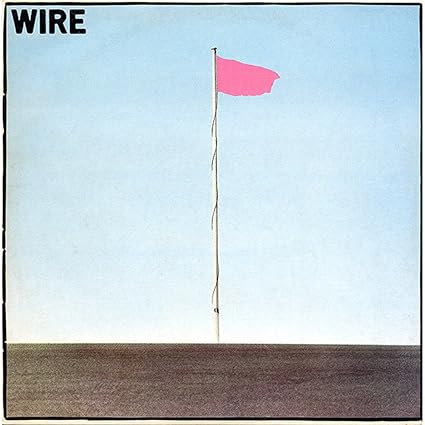
Wire
Pink Flag
About This Review
Re-Play reviews look back at landmark albums — how they were received at the time of release, the influence they've had on music in the years since, and where they stand today.
At Release
Wire arrived at the punk moment and immediately set about misunderstanding its requirements in the most productive possible way. Pink Flag, released in November 1977, was technically a punk record in its release context — the label was Harvest, the year was year-zero, the haircuts were acceptable. But the music was something else entirely. Its twenty-one tracks clock in at just over thirty-five minutes, which means the average song runs under two minutes. Many are considerably shorter. '106 Beats That' is one minute and thirty-three seconds of controlled repetition that ends before it has the opportunity to outstay its welcome.
The immediate reaction was bewilderment with a grudging admiration attached. Punk audiences were not entirely sure what to do with a band that played with technical precision, used silence as a compositional element, and seemed more interested in the structural properties of songs than in the emotional release that punk was supposed to provide. The music press was more receptive — there was something almost academic about Wire's deconstruction of the rock song, and critics with literary training recognized the approach from minimalism and conceptual art even if they had not encountered it in a rock context before.
The album did not chart significantly, which was predictable. It was never designed for the top forty. But its circulation within the small community of people who were paying close attention to what was possible in the wake of punk — the musicians, the fanzine writers, the independent label proprietors — was extensive and immediate. It passed from hand to hand with the urgency of a manifesto.
Pink Flag is the rare album that has not been diminished by the scholarship and reputation that has accumulated around it.
The Influence
Pink Flag is probably the single most influential record in this survey in terms of the sheer range of subsequent music it can claim as a descendant. Post-punk's emphasis on structure over expression, on the song as a designed object rather than an emotional outpouring, derives directly from the lessons Wire articulated here. The Minutemen built a career on the album's understanding of brevity. Sonic Youth took its interest in noise-as-texture and extended it into territory Wire themselves would later explore. Minor Threat and the American hardcore tradition took its compression and speed and stripped out whatever intellectual residue remained.
R.E.M., who covered 'Strange' on their Document album, absorbed Pink Flag's lesson about textural density — the way Wire layered guitars to create a wall of sound that was entirely distinct from Phil Spector's orchestral approach. Elastica, in the 1990s, borrowed so directly from Wire that two of their songs resulted in out-of-court settlements. The Strokes, Interpol, and essentially the entire post-punk revival of the early 2000s reached Pink Flag as an ancestor at approximately the same moment, which is why so many records from that era share a specific quality of deliberate restraint.
Where It Stands Today
Pink Flag is the rare album that has not been diminished by the scholarship and reputation that has accumulated around it. The songs are as sharp now as they were in 1977 — sharper, arguably, because we now have the full scope of what they made possible and can measure them against it. Hearing 'Reuters' or 'Ex Lion Tamer' today, you are hearing not just a punk single but the template for forty years of subsequent guitar-band experimentation.
Wire themselves continued to develop for decades, releasing records into the 2010s that remained genuinely adventurous. The fact that the band survived long enough to see its early work canonized, and continued making music while the canonization was happening, is itself unusual and instructive. Pink Flag does not need the biography to justify it. It stands alone as a fully realized argument about what rock music could be if it consented to think about itself.