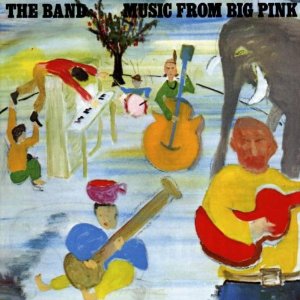
The Band
Music From Big Pink
About This Review
Re-Play reviews look back at landmark albums — how they were received at the time of release, the influence they've had on music in the years since, and where they stand today.
At Release
In the summer of 1968, rock music was straining under the weight of its own ambitions. Psychedelia had stretched the form to its outer limits; the technology of multitrack recording had opened compositional possibilities that bands were still working to exploit; the counterculture that rock had come to represent was reaching the limits of its own internal coherence. Into this atmosphere walked Music From Big Pink, an album recorded in a pink house in upstate New York by four Canadians and an Arkansan who had been playing music together for the better part of a decade, most of it as Bob Dylan's touring band. The record sounded like it had been made somewhere much older than 1968.
The response from the musicians who heard it first was closer to conversion than appreciation. Eric Clapton heard it while at the height of his fame with Cream and immediately began doubting the direction he was pursuing. George Harrison heard it and it altered the way he thought about the relationship between a musical group and its audience. In interviews given years after the fact, both men described the experience of hearing Music From Big Pink as a kind of correction — a reminder that rock music's roots in American vernacular forms were being abandoned in the pursuit of virtuosity and spectacle, and that those roots contained resources that had not yet been fully drawn upon. The album's reputation in the musical community was thus established before it had reached a wide audience.
The commercial performance was solid if not spectacular — the album reached number 22 in the UK and 30 in America, numbers that accurately reflect its position as a critically significant rather than a commercially dominant record. The reviews were admiring and somewhat awed, particularly by the collective vocal approach that the Band had developed: Levon Helm, Richard Manuel, and Rick Danko all sang lead and harmony in a blended style that had precedents in gospel and country but had never quite been applied to rock music in this way. The album's cover, a painting by Bob Dylan of himself and the Band as centaur-like mythological figures, announced its intentions clearly: this was not a record that intended to be contemporary.
"Music From Big Pink has never been cool in the sense that cool implies currency — its whole project was the rejection of contemporaneity in favor of permanence. What it has instead is authority."
The Influence
Music From Big Pink launched what is now called the Americana tradition — the conscious engagement of rock musicians with American roots music not as nostalgic exercise but as living resource. The album preceded and in many ways established the conditions for the country-rock movement that would follow through artists like Gram Parsons and the Flying Burrito Brothers, though the Band's approach was more integrated and less programmatic than most of what came after. Parsons had heard Music From Big Pink before he recorded Safe at Home, and the influence is audible not in any specific sonic element but in the fundamental premise: that rock music could look backward without being retrogressive.
The record's influence on the 1970s singer-songwriter tradition is equally significant. Its emphasis on the song as a vehicle for storytelling rather than performance, its restraint in the face of opportunities for virtuosic display, and its attention to the arrangement as a collective rather than a solo achievement all fed into the approach of artists from James Taylor to Jackson Browne to Bonnie Raitt. More recently, the record has been cited as a foundational influence by artists across the full range of what is now called Americana — from Gillian Welch to Jason Isbell to the War on Drugs. The specific quality they are reaching toward is the same one that arrested Clapton and Harrison in 1968: the sense that the music knows where it comes from and is not ashamed of it.
Where It Stands Today
Music From Big Pink is one of the most instructive examples of a record whose reputation has grown continuously without ever quite becoming fashionable. It has never been a cool record in the sense that cool implies currency and contemporaneity — its whole project was the rejection of contemporaneity in favor of permanence. What it has instead is authority, the kind that comes from having been right about something important at a moment when most people were wrong about it. The countercultural moment of the late 1960s was, in retrospect, building toward excess; the Band pointed toward a different road at precisely the right time.
The songs themselves are the ultimate argument for the album's endurance. 'The Weight,' 'Chest Fever,' 'Tears of Rage' — co-written with Dylan — and 'I Shall Be Released' are not simply good songs in the sense of being well-crafted commercial entertainments. They are songs that have entered the language in the way that very few popular compositions manage to do, becoming so thoroughly absorbed into the shared musical vocabulary that their origins become difficult to locate. When a contemporary musician wants to evoke a certain quality of Americana rootedness and emotional directness, they are almost always, knowingly or not, reaching toward what the Band defined in this building in upstate New York in the winter of 1967.