Miles Davis
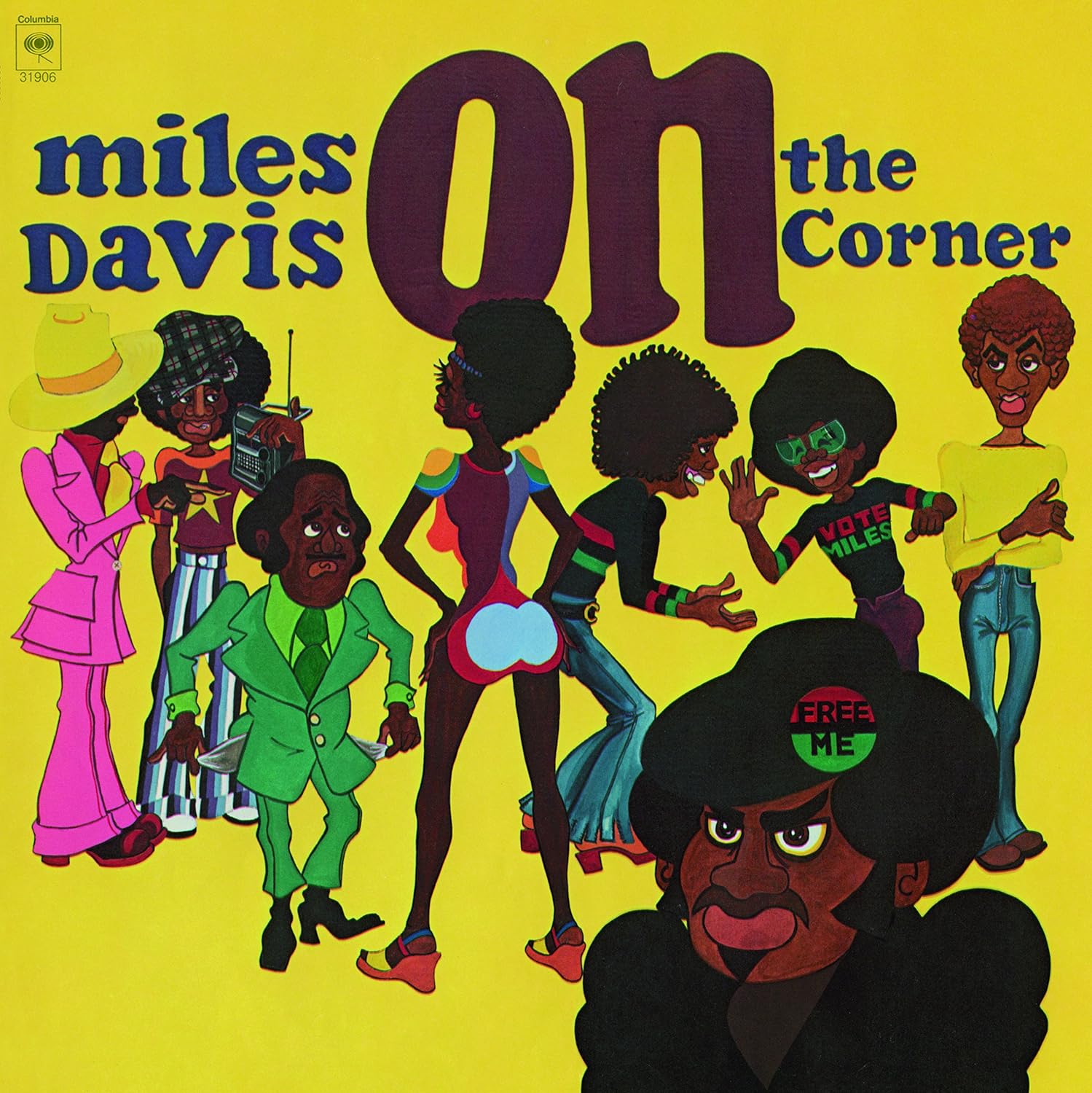
On the Corner
About This Review
Re-Play reviews look back at landmark albums — how they were received at the time of release, the influence they've had on music in the years since, and where they stand today.
At Release
Miles Davis had already reinvented jazz twice — once with the modal experiments of Kind of Blue in 1959 and again with the electric fusion of Bitches Brew in 1970 — and a reasonable observer might have concluded that two reinventions were sufficient, that the third time he transformed himself he would simply be elaborating on the second. On the Corner, released in October 1972, demonstrated that this assumption was wrong in both directions: it was not an elaboration of Bitches Brew, and it was not a jazz record in any sense that the word had previously carried. It was something stranger and more aggressive — a record built from the rhythmic logic of James Brown and Sly Stone filtered through the compositional approach of Stockhausen, played by a group of musicians who were given partial scores, competing instructions, and a producer determined to edit their performances into something that bore no resemblance to a conventional studio session.
The critical reception was among the most hostile Davis had ever received, which is a significant statement given that Bitches Brew had itself provoked considerable resistance from the jazz establishment. The difference was that Bitches Brew had retained sufficient continuity with the jazz tradition — in its improvisatory structure, in the identifiable relationship between its musicians, in its maintenance of something like solos and something like ensemble passages — to allow jazz critics to locate it within their frameworks even while objecting to its departures. On the Corner offered no such courtesy. Down Beat magazine, which had been the primary institutional voice of jazz criticism since the 1930s, gave it a one-star review. Rolling Stone, which had celebrated Bitches Brew as a crossover achievement, found it 'unlistenable.' Davis himself seemed actively pleased by the rejection.
The commercial performance confirmed that Davis's calculation — that the Black youth audience that had found Bitches Brew too complicated and too jazz would find On the Corner more accessible — was incorrect, or at least premature. The album sold modestly, failed to reach the constituency Davis had identified, and was quietly allowed to drift out of print. Columbia Records, which had backed every previous reinvention with promotional resources appropriate to a major artist, seemed uncertain how to position it and largely did not try. On the Corner entered a kind of commercial limbo that would last for more than a decade, during which time its influence was transmitted not through sales or radio play but through the copies that circulated among a small community of musicians and producers who grasped its implications before the wider culture had developed the context to receive them.
On the Corner was not an elaboration of Bitches Brew and not a jazz record in any sense the word had previously carried — it was something stranger, built from the rhythmic logic of James Brown filtered through the compositional approach of Stockhausen.
The Influence
The list of musicians who have cited On the Corner as a transformative encounter reads like a map of the most adventurous popular music made in the subsequent fifty years. Prince heard it and understood that funk rhythm could be a compositional architecture rather than a groove to play over. Karlheinz Stockhausen, who was already an acknowledged influence on Davis, encountered the record as a kind of reply and was reportedly astonished at what Davis had done with the ideas he had transmitted. The hip-hop producers who would emerge in the 1980s — primarily through drum machine technology that On the Corner had effectively anticipated in its approach to rhythm — were building on foundations that Davis had poured without their knowledge.
The most direct and demonstrable influence is on the specific practice of editing and assembling music from fragments. Davis and his producer Teo Macero constructed On the Corner from hours of studio material using tape editing techniques borrowed from musique concrète, creating a record whose apparent continuity conceals a massive amount of invisible construction. This approach — the studio as editing suite rather than performance space, the final record as assembled object rather than captured event — is so thoroughly normalized in contemporary music production that it requires an effort of imagination to recognize it as radical. On the Corner was one of the primary places where this normalization began. Every producer who currently works by laying up samples, loops, and fragments to construct a track that was never played in real time is, at several removes of influence, working from principles that Davis and Macero developed in Columbia's 30th Street Studio.
Where It Stands Today
On the Corner has been rehabilitated to the point where the original hostile reviews now function as evidence of the record's importance rather than arguments against it — the standard dynamic for genuinely ahead-of-its-time music, where the initial resistance eventually becomes part of the mythology. Columbia reissued it with extensive liner notes and contextual materials in 2000, and the jazz press that had dismissed it thirty years earlier lined up to reassess. The reassessment was unanimous: this was not a failure or an aberration but a record that had been misunderstood because the cultural context for understanding it had not yet arrived.
Heard today, On the Corner sounds less like a jazz record or a funk record than like a template for the electronic music and hip-hop production that would not fully materialize for another decade. The percussion layers, the way the bass functions as rhythm rather than harmony, the deliberately claustrophobic density of the mix, the refusal to provide melodic relief — these are the characteristics of a record that was imagining a future sonic landscape and building a provisional model of it from the available materials. The model has been refined and expanded by fifty years of subsequent music. The original retains its authority because it got the fundamental architecture right when nobody else was even asking the question.