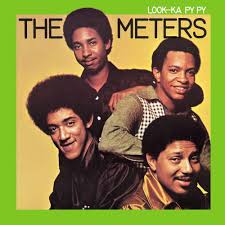
The Meters
Look-Ka Py Py
About This Review
Re-Play reviews look back at landmark albums — how they were received at the time of release, the influence they've had on music in the years since, and where they stand today.
At Release
There's a useful way to understand how little attention New Orleans was getting from the music industry in 1969: the city that invented jazz, that had been producing top-tier R&B for two decades, was essentially invisible to rock critics and radio programmers alike. The music press had already written its origin story about American rhythm music, and it ran through Memphis and Detroit, not the Crescent City. So when Josie Records quietly dropped Look-Ka Py Py at the tail end of December, nobody was especially ready for it.
What the Meters had put together was deceptively simple on paper: twelve instrumental tracks, no horns, no strings, almost no overdubs. Art Neville on keys, Leo Nocentelli on guitar, George Porter Jr. on bass, and Joseph "Zigaboo" Modeliste on drums. Four guys, one room, no frills. But what they played — and more importantly, how they played it — was something genuinely new. The rhythmic relationship between Modeliste's snare and Porter's bass was tight in a way that didn't feel labored. It felt inevitable, like the two instruments had been arguing quietly for years and finally agreed on something.
The title track reached No. 11 on the R&B chart, which was respectable, but it didn't make anyone famous. Critical coverage was thin to nonexistent outside the soul and funk press. The album sold modestly and then largely disappeared from mainstream view. Josie Records wasn't exactly equipped to push it into the right rooms. What it did instead was circulate — slowly, through crates and word of mouth — among the people who would eventually matter most to its legacy.
The grooves breathed. They didn't announce themselves. They simply existed, incontrovertible as gravity.
The Influence
The Meters' influence operates differently from most canonical records. They're not a band you can point to and say, "that's where the riff came from," the way you can trace a Led Zeppelin song back to a blues recording. Their impact is more structural, more about how a rhythm section should think about its job. They established a posture — restrained, locked, patient — that runs through a remarkable span of music made in the decades that followed.
George Clinton acknowledged them early and often. When he was building the Parliament-Funkadelic infrastructure in the early 1970s, the Meters were already in the room as a reference point. Questlove, who has probably spent more time thinking about funk drumming than anyone alive, has cited Modeliste specifically as a formative model — not just for the patterns, but for the idea that a drummer could be the least flashy person in the group and still be the most important one. Nocentelli's guitar work had a similar downstream effect: his parts are almost aggressively understated, perpetually in service of the pocket, and you can hear that sensibility echoed in players ranging from Prince's studio session guitarists to the rhythm tracks on early hip-hop records.
The sample culture that emerged in the 1980s and 1990s treated Look-Ka Py Py like a quarry. The grooves were clean, the separation between instruments was good even by the standards of later recording technology, and the rhythmic loops had an internal logic that made them easy to chop and recontextualize without losing their identity. A partial census of who's sampled this record reads like a history of hip-hop production: De La Soul, Gang Starr, N.W.A., A Tribe Called Quest. DJ Premier reportedly kept a Meters album within reach at all times during the Illmatic sessions, though it's not always clear which one.
Where It Stands Today
The record got a proper critical reassessment in the early 2000s, when Pitchfork's expanding historical canon and the 2003 Rolling Stone 500 Greatest Albums list (where it landed at No. 218) gave it a new audience. A generation of listeners encountered it for the first time through those lists, or through samples they'd been hearing for years without knowing the source. What they found was an album that didn't require any cultural archaeology to appreciate — it just sounded good, immediately, the first time through.
There's something worth noting about the production, which was handled by Allen Toussaint and Marshall Sehorn. The mix has held up extraordinarily well. Each instrument sits in its own space without being over-separated, and the whole thing has a warmth that a lot of records from this period — and from the heavily compressed digital era — don't come close to. The kick drum sounds like a kick drum. The bass sounds like a bass. It's recorded the way you'd want to record a band that has spent years learning exactly what they sound like together.
What the album asks of a listener is a certain willingness to pay attention. There aren't big moments. There aren't choruses. The songs resolve by running out of time rather than by building to anything. That's either a feature or a bug depending on what you're expecting, and first-time listeners looking for the kind of payoff they get from rock or pop will probably find it frustrating. But the second listen is usually the one that does it — when you start to hear the conversations happening between instruments, the small adjustments Modeliste makes from one bar to the next, the way Nocentelli's guitar line anticipates Porter's bass rather than following it. That's when the album stops being background music and starts being something you want to figure out.
Look-Ka Py Py is one of those records that rewards expertise without requiring it. You can put it on at a party and it'll work. You can also spend a month with it and still be finding things. That combination is genuinely rare, and it's a large part of why the album's reputation has only grown in the fifty-plus years since it went largely unnoticed on release.