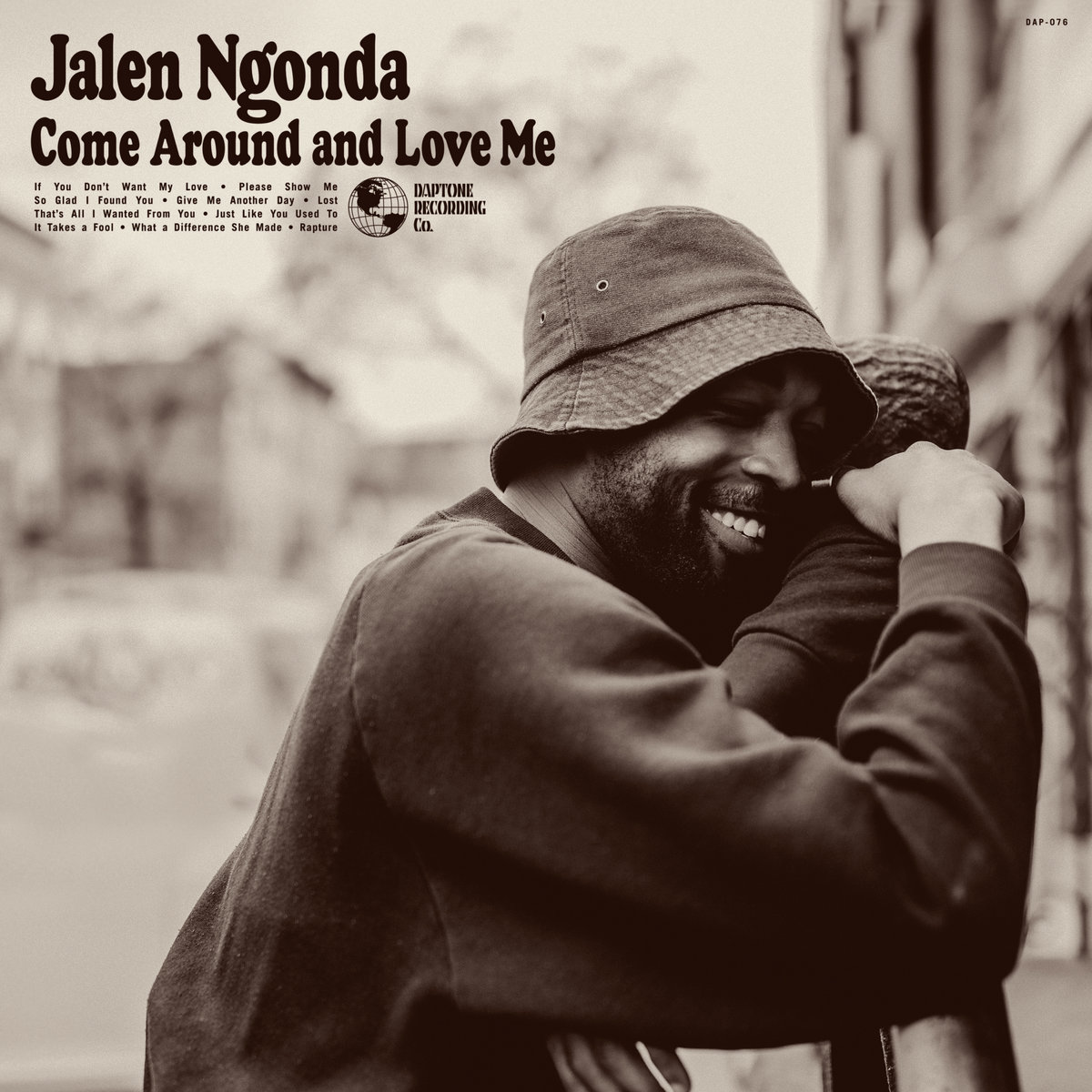
Jalen Ngonda
Come Around and Love Me
I never really connected with my father's music — not for lack of trying. He placed The Beatles on the highest possible altar, as any right-thinking person of his generation might, but his true passion was the Beach Boys. Growing up landlocked in Wyoming, it always struck me as wonderfully strange that a man who had never seen a surfboard in his life could feel so deeply moved by music that seemed to belong entirely to a California coastline. It took me years to understand that the geography was never the point. Music finds its own routes through a person. You don't choose what moves you — it chooses you. My own ears never drifted toward those early rock and roll shores. But the lesson stuck. When Jalen Ngonda's father sat his eleven-year-old son down in suburban Maryland and played him a Temptations record, he set in motion something that would eventually produce one of the most quietly extraordinary debut albums of this decade.
"Ngonda has studied all of it, absorbed every lesson, and emerged the other side not as an imitator but as someone who simply speaks this language natively."
Young Jalen, a self-described video game nerd with no particular ambitions toward a stage, was given a DVD copy of the landmark TV series Roots by his father. The disc happened to include a preview for a documentary about The Temptations. He watched that preview so many times — rewinding just to reach it again — that his father eventually bought him a Temptations CD. That was the door. What followed was a decade-long obsession — Motown bleeding into Stax, into Philly soul, into the Impressions and Curtis Mayfield and Marvin Gaye and Harold Melvin and the Blue Notes. By sixteen he could play drums, guitar, piano, and had begun to discover what his voice could do. His family and church congregation helped raise the funds to send him — at around nineteen or twenty — across the Atlantic to study at Liverpool's Institute for the Performing Arts, Paul McCartney's school, on the same streets the Beatles had walked. There, surrounded by classmates citing Oasis and Rage Against the Machine, Jalen Ngonda was the kid in the corner talking about Sam Cooke and Nina Simone.
The route from Liverpool to Daptone Records ran through a last-minute support slot for the bandleader Jools Holland. Neal Sugarman, Daptone's co-founder, was in the audience that night. He heard what he needed to hear. Plans for an album were agreed between them almost immediately. Then the COVID-19 pandemic arrived approximately one month later and shut the world down. In 2021, Ngonda finally flew to Brooklyn and began work at Hive Mind Studios with producers Vincent Chiarito and Mike Buckley, both former members of Charles Bradley's Extraordinaires. Bradley — the Screaming Eagle of Soul, one of the most emotionally devastating performers Daptone ever put before a microphone — died in 2017. His musicians now carry something forward in rooms like this one. Every time Chiarito and Buckley work, they are keeping a tradition alive. They helped Ngonda build eleven songs that earn a place in that tradition.
Come Around and Love Me runs to thirty-three minutes — lean, purposeful, without a wasted second. From the opening title track, built on a Thom Bell-style string arrangement and a vibraphone line that might have floated off a Gamble and Huff session tape circa 1972, the album announces its intentions with complete confidence. This is Motown in its most sophisticated mode: the What's Going On era Marvin, the poised elegance of the Four Tops at their peak, the swooning devotional intensity of Smokey Robinson. Ngonda has studied all of it, absorbed every lesson, and emerged the other side not as an imitator but as someone who simply speaks this language natively.
What distinguishes Ngonda from the merely capable revivalists is his voice. It is an instrument of genuine and startling range — capable of raw, wrung-out emotion one moment and a falsetto of almost unbearable sweetness the next. On That's All I Wanted From You, the album's most direct and propulsive track, he stretches the voice into something close to a shout, the backing singers rising to meet him in a moment of collective urgency that feels less like a recording and more like a room suddenly catching fire. The slow material is equally commanding. Lost draws from the same emotional well as Harold Melvin and the Blue Notes' most desperate moments — that particular quality of a love gone wrong that doesn't shout but aches. What a Difference She Made, written in London with collaborator Sam Knowles and shaped after the sound of Curtis Mayfield and the Impressions, sounds like a song that has always existed, waiting to be found rather than written. Just Like You Used To, also from those London sessions, is all doo-wop harmonies and wistful longing — a song with no right to be as affecting as it is, until Ngonda opens his mouth. The album's closer, Rapture, ends things on a full orchestral sweep — Ngonda's most expansive vocal performance on the record, one that leaves you wanting to start again from the top.
There is not a weak track here. If you are already a Daptone believer, this sits comfortably alongside the best the label has ever released. If you are new to the soul revival, Come Around and Love Me is as good a place to start as any record I can recommend. Elton John put the title track on his personal list of favourite songs of 2023. Snoop Dogg praised it. The BBC invited Ngonda to perform with their Concert Orchestra. The world is catching up to something that was always going to be inevitable the moment a kid in Maryland watched that Temptations preview one more time.