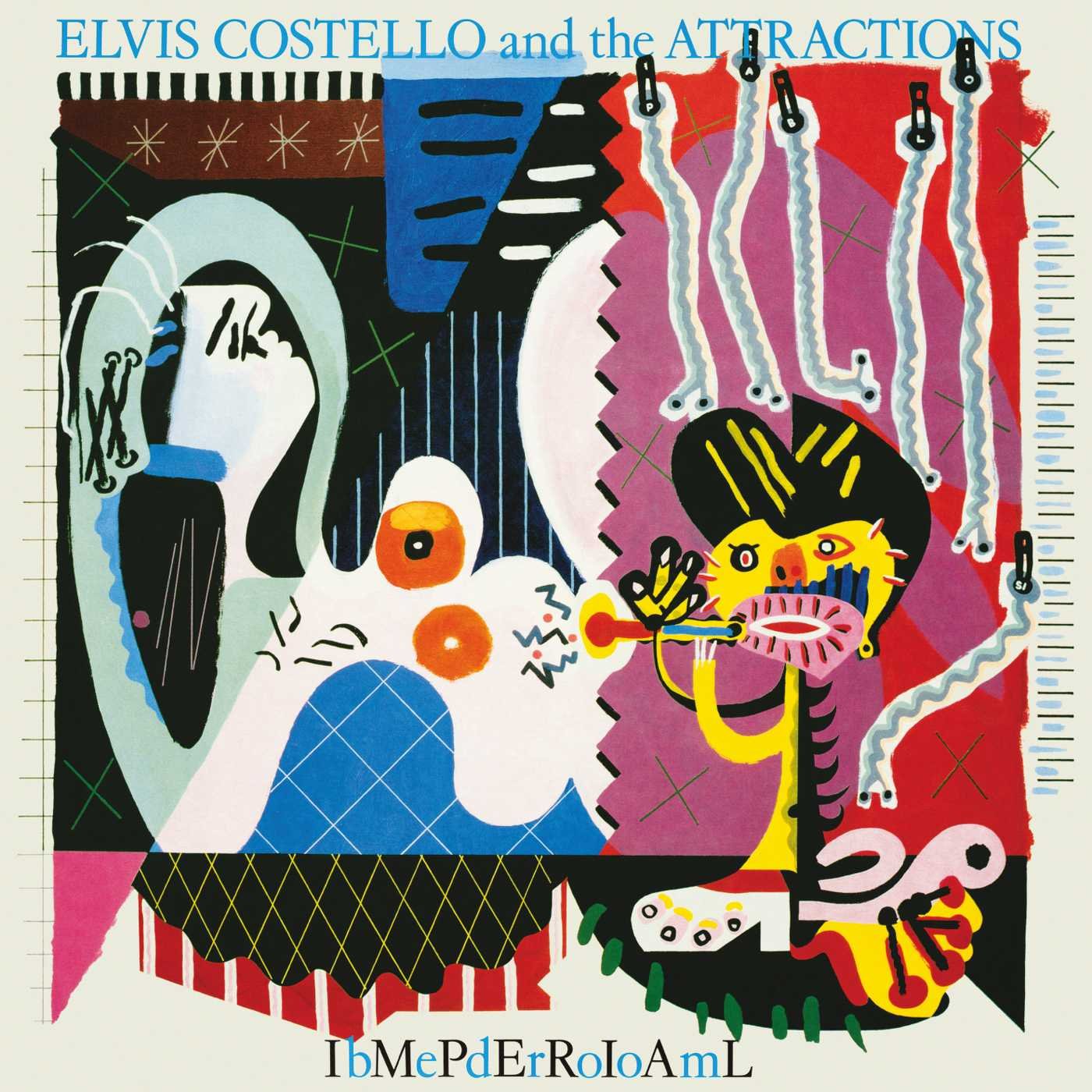
Elvis Costello & the Attractions
Imperial Bedroom
About This Review
Re-Play reviews look back at landmark albums — how they were received at the time of release, the influence they've had on music in the years since, and where they stand today.
At Release
Elvis Costello had, by 1982, already made six albums in six years, each one pursuing a different set of formal and generic ambitions with an energy that suggested the albums were conversations he was conducting with himself about the history of popular music. Trust and Almost Blue had been, respectively, a consolidation and an apparent detour into country. Imperial Bedroom was the record on which the ambitions were expanded to their full and alarming scope. Producer Geoff Emerick — who had engineered every significant Beatles record — brought to the sessions a standard of sonic complexity that dwarfed anything in Costello's previous catalogue.
The British critical response was one of sustained, somewhat awed admiration. NME gave it ten out of ten and used the word 'masterpiece' without apparent embarrassment. Rolling Stone, in the United States, was more cautious, as Rolling Stone tends to be when confronted with music that demands more than a single pass to reveal itself. The album did not produce any significant hit singles, which was entirely expected — its ambitions were compositional and structural, not commercial. The closest thing to an accessible single, 'Man Out of Time,' was an intricately constructed meditation on obsession and self-deception that required three listens before its full architecture was audible.
The sessions were by all accounts extraordinary and exhausting. Costello had written more material than could possibly fit on a single record, and the sequencing choices were agonized over at length. Every song interlocked with the others thematically — adultery, longing, resentment, and self-knowledge circled through the record from multiple angles, observed with a precision that had more in common with the short story form than with the song cycle tradition Costello was nominally working in.
Imperial Bedroom exists in a category the music of its era rarely occupied: genuinely inexhaustible — deep in the sense that a piece of serious literature is deep, because the density of what it contains exceeds what any single engagement can fully account for.
The Influence
Imperial Bedroom's influence is most visible in its demonstration that a rock album could aspire to the density and complexity of the Great American Songbook tradition without becoming either a nostalgia exercise or a parody. The harmonic language Costello was using — jazz-inflected, rhythmically supple, emotionally ambiguous in ways that simple major/minor writing cannot achieve — gave ambitious pop musicians a template for how to reach toward those traditions while retaining their own identity.
The record's particular combination of lyrical density and melodic generosity was absorbed by a generation of British songwriters who emerged in its wake: prefab Sprout, The Beautiful South, and Crowded House all show specific traces of it. In America, the influence was more diffuse but identifiable in the better work of the alternative rock era — those moments when a band paused the angst long enough to consider the construction of a chord change or the internal structure of a verse. Costello's later work with Burt Bacharach, years after Imperial Bedroom, was a natural extension of the harmonic ambitions audible on this record as far back as 1982.
Where It Stands Today
Imperial Bedroom has not been fully absorbed by the culture in the way that the best-known records in this series have been. It is not taught in rock history courses as an obligatory text the way Unknown Pleasures or Remain in Light is. This is partly because its pleasures are intricate rather than immediate, and partly because the critical vocabulary for discussing its specific achievements — the relationship between harmonic complexity and emotional directness, the way it uses orchestration as dramatic intensification rather than decoration — has not fully developed within pop criticism.
What is certain is that it rewards return visits with a consistency that very few albums of any era can match. 'Almost Blue,' 'Beyond Belief,' and 'Pidgin English' each reveal new details on the hundredth hearing that were not fully audible on the ninety-ninth. The album exists in a category that the music of its era rarely occupied: genuinely inexhaustible. Not mysterious in the pretentious sense, but deep in the sense that a piece of serious literature is deep — not because it withholds meaning, but because the density of what it contains exceeds what any single engagement can fully account for.