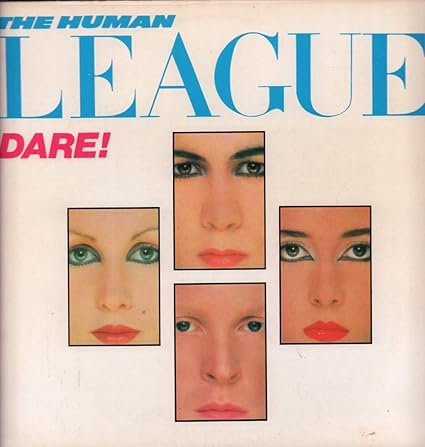
The Human League
Dare
About This Review
Re-Play reviews look back at landmark albums — how they were received at the time of release, the influence they've had on music in the years since, and where they stand today.
At Release
It is difficult to convey, from a contemporary vantage point, how genuinely shocking it was that Dare became a mainstream phenomenon. The Human League that recorded it was a reconstituted organism: Phil Oakey had fired half his band and replaced them with two teenage girls he met at a disco in Sheffield, neither of whom had sung professionally. The surviving members were committed electronic purists who used synthesizers not as color but as the entire orchestra. There was no guitar. There was no conventional rhythm section. What existed was a highly controlled arrangement of keyboards, sequencers, and voices — and it sold four million copies.
British music critics of the time were genuinely caught between the twin imperatives of their trade: snobbery and prescience. Some found Dare's unabashed pop ambitions a betrayal of the more austere experimentation the band had pursued on its earlier records. Others, correctly, identified it as evidence that synthesizer music had graduated from an art-world experiment to a fully realized popular form. The song 'Don't You Want Me' became one of the best-selling singles in UK chart history and created a mild cultural crisis among people who felt themselves obligated to take it seriously without quite knowing how.
The production by Martin Rushent was an engineering achievement as significant as any arrangement decision. Rushent created a sonic environment that was simultaneously immaculate and warm — a genuine tension, given that all the sounds were generated electronically. The bass frequencies hit with physical authority. The high-end shimmer of the synthesizers was precise without being antiseptic. The whole thing gleamed. Every subsequent synthesizer pop record of the 1980s was, consciously or not, measured against this standard.
Heard carefully, on a good system, with the production credits in mind rather than the cultural baggage, Dare is astonishing.
The Influence
Dare made synthesizer-driven pop not merely acceptable but aspirational. Before it, electronic music in the UK occupied a cultural position somewhere between avant-garde respectability and science-fiction novelty. After it, every major British pop act of the 1980s had to reckon with what it proved: that you could make records of genuine emotional impact without a guitarist in the room, and that these records could sell in quantities that would embarrass rock traditionalists.
The specific production aesthetic Rushent created with the band — the gated machine rhythms, the layered melodic synthesizer voices, the separation between elements that gave each sound room to breathe — became the template for what the wider world called synth-pop. Depeche Mode, OMD, the Pet Shop Boys, Erasure, and many acts that reached much larger audiences all inherited specific techniques and attitudes from what Dare demonstrated was possible. The record's influence extends forward to contemporary artists working in synthwave, hyperpop, and the broad territory of electronically produced mainstream pop, which is to say most of what now constitutes the pop mainstream.
Where It Stands Today
Dare occupies a slightly awkward position in the contemporary listening landscape because its influence was so total that it can be difficult to hear it clearly through the accumulated echo of everything it inspired. The danger with such formative records is that they begin to sound like imitations of themselves, or like background music from a period film set in the early 1980s, when in fact they are the source of the aesthetic rather than a reflection of it.
Heard carefully, on a good system, with the production credits in mind rather than the cultural baggage, Dare is astonishing. Rushent's bass sounds remain among the finest examples of low-frequency synthesis ever committed to record. 'The Sound of the Crowd' is as kinetic as any club track made in the four decades since it appeared. And the vocal interplay between Oakey's baritone and the voices of Joanne Catherall and Susan Ann Sulley has a complexity and warmth that no amount of technological sophistication has managed to replicate by assembling a similar set of parts.