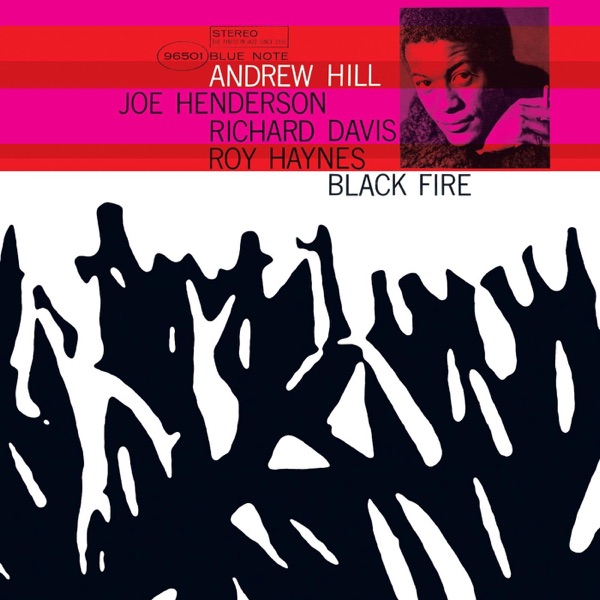
Andrew Hill's Blue Note debut as a leader, recorded November 8, 1963 at Rudy Van Gelder's Englewood Cliffs studio and released on Blue Note in April 1964. Producer Alfred Lion was so taken with Hill that he later compared him to Thelonious Monk in importance, and signed him to a torrent of recording dates — Hill cut four classic Blue Note albums in roughly five months. Black Fire is the one that started it.
The quartet is Hill on piano, Joe Henderson on tenor saxophone, Richard Davis on bass, and Roy Haynes on drums. Philly Joe Jones was originally booked on drums but couldn't make the date, so Haynes stepped in — and the loose, polyrhythmic feel he brings turns out to be the perfect frame for Hill's writing. All seven compositions are Hill originals.
Cool stuff:
- All seven tunes are Hill originals. The opening "Pumpkin" is a 38-bar mixed-meter piece — the kind of structural curveball that defines the record
- Roy Haynes was the substitute. Philly Joe Jones was originally booked but had a scheduling conflict; Haynes' looser feel ended up shaping the album's identity
- Alfred Lion compared Hill to Thelonious Monk in terms of compositional importance, and rushed him into the studio for four leader dates in five months
- Hill's influence runs deep: Vijay Iyer and Jason Moran both cite Black Fire and Hill's Blue Note work as foundational for the modern jazz piano vocabulary
- Reissued in 2019 as part of the Blue Note Tone Poet Series, mastered all-analog by Kevin Gray from the original tapes
Spin it for: the moment a singular composer-pianist arrives on Blue Note fully formed — angular, harmonically restless, but full of feeling.
Standouts: "Pumpkin" · "Subterfuge" · "Black Fire" · "McNeil Island"
Sources: Wikipedia · uDiscover Music · Tidal Magazine · Blue Note Records · Jazz Journal